Researchers show that restoring IGFBP5 reduces stem cell senescence and enhances periodontal bone regeneration through WNT5B signaling
CHENGDU, SICHUAN, CHINA, October 2, 2026 /EINPresswire.com/ — Periodontitis can damage tooth-supporting bone as stem cells lose their regenerative capacity with age. Researchers at Sichuan University found that IGFBP5 reduced cellular senescence and restored bone-forming ability in dental follicle stem cells by modulating WNT5B-related signaling. An engineered hydrogel carrying IGFBP5-overexpressing cells improved periodontal bone regeneration in rats. The findings highlight a potential strategy for rejuvenating therapeutic stem cells and supporting the development of regenerative treatments for age-related periodontal bone loss.
Periodontitis can cause progressive loss of the tissues and bone that support teeth, while aging can weaken the stem cells needed for natural repair. Dental follicle stem cells (DFSCs) are promising candidates for periodontal regeneration, but these cells can themselves become senescent, reducing their ability to proliferate and form bone. A key question is how to restore the function of these aging cells before they are used therapeutically.
Addressing this challenge, a research team led by Professor Jun Liu from the Department of Orthodontics, West China Hospital of Stomatology, Sichuan University, China, investigated the role of insulin-like growth factor binding protein 5 (IGFBP5) in DFSC aging and periodontal repair. The researchers combined cellular experiments, gene-expression profiling, protein analyses, a biomaterial delivery system, and a rat model of periodontitis to examine how IGFBP5 affects senescence and bone formation. Their findings were published online in Volume 18 of the journal International Journal of Oral Science on September 15, 2026.
The researchers first found that IGFBP5 expression declined markedly when human DFSCs became senescent after repeated cell division or oxidative stress. In the two senescence models, IGFBP5 fell by more than fivefold under oxidative stress and by 69-fold during replicative senescence. These aging cells also showed higher levels of oxidative stress, reduced viability and migration, and weaker bone-forming activity, indicating that cellular aging can compromise their regenerative potential.
“We found that restoring IGFBP5 could counter several features of stem cell senescence,” says Prof. Liu. “Improvements in cell survival and bone-forming ability suggested that IGFBP5 may help preserve the regenerative function of DFSCs during aging.”
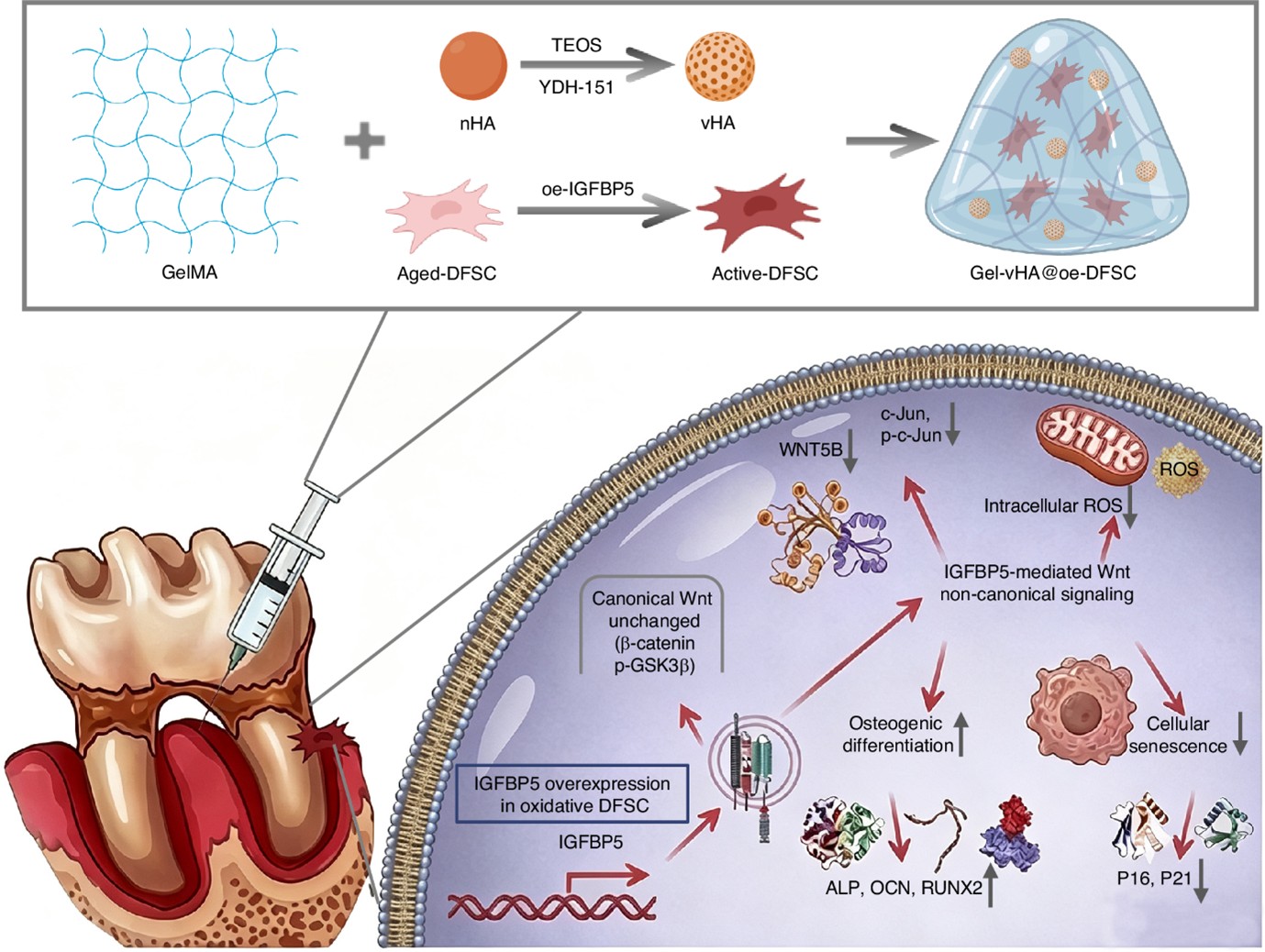
Further experiments showed that increasing IGFBP5 reduced senescence-associated changes, lowered reactive oxygen species, improved cell-cycle activity, and restored markers of bone formation in stressed DFSCs. Gene-expression analysis pointed to the non-canonical Wnt pathway as an important part of this response. In particular, IGFBP5 overexpression reduced WNT5B and c-Jun, while components of the canonical Wnt/β-catenin pathway remained largely unchanged.
WNT5B was then identified as a downstream factor in the IGFBP5 response. Adding WNT5B weakened the bone-forming effects produced by IGFBP5 and increased a cellular senescence marker, while blocking WNT5B partially improved the senescent and osteogenic features of replicatively senescent cells. Together, these findings suggest that IGFBP5 supports the function of aging DFSCs, at least partly by suppressing WNT5B-related signaling.
To translate these findings toward treatment, the team developed a cell-delivery scaffold called Gel-vHA@oe-DFSC. The system combines a gelatin methacryloyl (GelMA) hydrogel, vinyl-functionalized nanohydroxyapatite, and DFSCs engineered to overexpress IGFBP5. In laboratory tests, the hydrogel supported cell survival under oxidative stress, promoted cell spreading, and enhanced osteogenic activity. In rats with experimentally induced periodontitis, the treatment improved alveolar bone quality, increased bone mineral density and bone volume fraction, and produced tissue with less inflammation and better collagen organization.
“Our results suggest that rejuvenating therapeutic stem cells before delivery may be more effective than simply transplanting untreated cells,” says Prof. Liu. “The scaffold also provides a way to support these modified cells at the periodontal defect site while they promote local tissue repair.”
The study may have implications beyond periodontitis because stem-cell aging is a broader challenge in regenerative medicine. IGFBP5 could potentially serve as a molecular indicator of DFSC aging and as a target for restoring regenerative capacity before transplantation. The findings also support further investigation of hydrogel-based delivery systems and the IGFBP5-WNT5B pathway in aged human cells. However, the authors note that additional studies are needed in cells from older patients and in larger animal models before clinical application.
Overall, the study identifies IGFBP5 as a promising regulator of DFSC senescence and bone-forming function. By combining cell rejuvenation with localized delivery, Gel-vHA@oe-DFSC improved periodontal regeneration in a rat model, providing a potential strategy to address age-related periodontal bone loss and a foundation for future regenerative therapies.
***
Reference
Title of original paper: IGFBP5 alleviates periodontitis by reversing human dental follicle stem cell senescence via the non-canonical Wnt pathway
Journal: International Journal of Oral Science
DOI: 10.1038/s41368-026-00463-2
About Sichuan University, China
Sichuan University (SCU), founded in 1896, is a premier national institution in Chengdu, China, operating directly under the Ministry of Education. As an elite Double First Class University, it seamlessly blends a rich academic history with cutting-edge research across three sprawling campuses: Wangjiang, Huaxi, and Jiangan. SCU offers a comprehensive range of disciplines, earning global acclaim for its high-impact engineering, science, and legendary medical programs at the West China Center of Medical Sciences. Dedicated to global excellence, the university fosters active international collaboration and innovation for its diverse community of over 100,000 brilliant students and scholars worldwide.
Visit: https://en.scu.edu.cn/
About Professor Jun Liu from Sichuan University, China
Dr. Jun Liu, DDS, PhD, is a renowned Professor and researcher at the Department of Orthodontics, West China Hospital of Stomatology, Sichuan University, China. Affiliated with the State Key Laboratory of Oral Diseases and the National Clinical Research Center for Oral Diseases, his work spans dentistry, oral surgery, and medicine. He specializes in clinical orthodontics, exploring advanced orthodontic therapies, clear aligner mechanics, and complex adult treatments. Academically, his research focuses on bone remodeling and regenerative biology, investigating force-induced osteogenic differentiation, responses to mechanical stimuli, and bone homeostasis. He remains an active and key contributor to global dental education.
Funding Information
This work was supported by the National Natural Science Foundation of China (82170934) and Sichuan Science and Technology Program (2024YFFK0201).
Yini Bao
The International Journal of Oral Science
+862885546461 ext.
ijos@scu.edu.cn
Visit us on social media:
X
Legal Disclaimer:
EIN Presswire provides this news content “as is” without warranty of any kind. We do not accept any responsibility or liability
for the accuracy, content, images, videos, licenses, completeness, legality, or reliability of the information contained in this
article. If you have any complaints or copyright issues related to this article, kindly contact the author above.

Media gallery