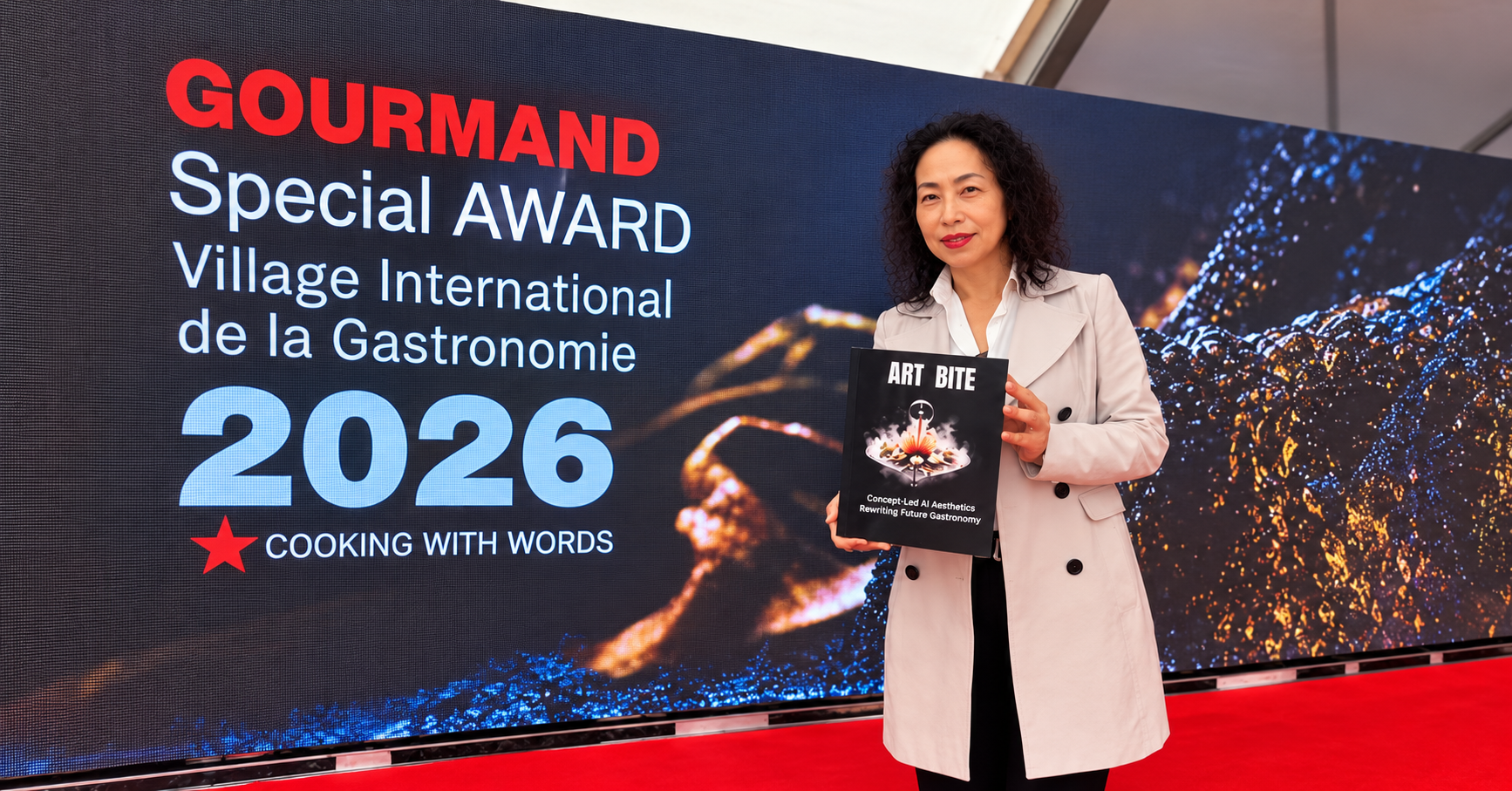
Building on three Gourmand-winning works, Yang moves Space-Art Cuisine toward human-scale experiences for the Space Experience Economy.
PARIS, SHANGHAI, FRANCE, September 28, 2026 /EINPresswire.com/ — Following a Special Award presented during the Gourmand Awards’ 30th-anniversary celebration at the Village International de la Gastronomie in Paris, three-time Gourmand World Awards-winning author Aimei Helen Yang is advancing Space-Art Cuisine into a new stage of multidisciplinary collaboration, extending the concept beyond imagining future food toward creating human-scale experiences of worlds people have not yet reached.
“Space-Art Cuisine began with a simple question: how can we imagine the universe through food?” Yang said. “The next step is to move beyond imagining future food and begin creating experiences that chefs, artists, designers and hospitality creators can interpret in their own ways. The recognition in Paris gives this next stage a meaningful place to begin.”
The recognition came during the 10th-anniversary edition of the Village International de la Gastronomie at Place de la Concorde. Held under the High Patronage of French President Emmanuel Macron, with renowned chef Alain Ducasse serving as patron, the event brought together 73 countries and regions and more than 61,000 visitors around gastronomy, culture and culinary diplomacy.
The development builds on a progression across Yang’s three consecutive Gourmand-winning works. Futuristic Flavors: AI Edition (2024) explored AI as a catalyst for culinary creativity; Next Bite: Space-Art Culinary Journey (2025) moved toward food as a human-scale interface for exploring space through sensory experience; and ART BITE (2026) advanced “Imagination Infrastructure”—the human capacity to create meaning, aesthetics and cultural interpretation around technological possibility. The next stage of Space-Art Cuisine turns that conceptual foundation toward multidisciplinary creation and real-world experience.
Space-Art Cuisine treats space not as a decorative motif of stars, planets or rockets, but as a source of physical, psychological and cultural conditions for creative interpretation. Gravity, orbit, changing light, distance, isolation, time and memory can become creative inputs expressed through taste, texture, temperature, aroma, structure, movement, sound, tableware and spatial design. AI can expand what can be imagined, while human creators give those possibilities cultural, sensory and emotional meaning, bringing them into experiences people can perceive, participate in and remember.
Drawing inspiration in part from fashion’s use of collections to organize a creative vision while preserving individual expression, Yang is developing a collection-based collaborative format for Space-Art Cuisine. Each collection begins with a shared future concept that chefs and creators across wine, photography, art, design and hospitality can interpret through their own professional and cultural languages. A lunar-themed collection, envisioned as an early creative focus, could explore one-sixth gravity, the boundary between light and darkness, silence, distance from Earth, altered perceptions of time and memories of home—allowing culinary, visual, sensory and spatial interpretations to emerge from the same lunar conditions. “The purpose is not to tell chefs what the future should taste like,” Yang said. “I create the concept and the creative territory; each creator brings a different language. That is what allows the work to keep evolving.”
The approach can extend beyond gastronomy into dining and hospitality experiences, exhibitions, cultural programs, publications, luxury experiences and brand collaborations, creating a common territory where gastronomy, hospitality, wine, art and design can explore future consumer experiences together. In this sense, the shift is from designing future food to designing how people experience the future.
This evolution also connects directly with Yang’s broader work on the Space Experience Economy, which she explored at the International Space Development Conference (ISDC) 2026 as the human-facing experiences and potential markets that could develop alongside the physical infrastructure of the New Space Economy. Rockets, spacecraft and future orbital or lunar infrastructure can create access, but infrastructure alone does not determine what people will want to experience, remember, celebrate or value. Space-Art Cuisine provides an accessible creative field for beginning to explore those questions before future destinations become widely accessible. The lunar theme also aligns with a broader conversation around longer-term human presence on the Moon. ISDC 2027 in Los Angeles will convene under the theme “At Home on the Moon.” The parallel raises a cultural question central to Yang’s work: as living beyond Earth becomes a more prominent subject of technical and industry discussion, how might human senses, hospitality, memory and culture evolve with it?
The evolution of Space-Art Cuisine also reflects the progression of Yang’s international work in 2026: from exploring AI and culinary imagination at the Beijing International Book Fair, to developing the Space Experience Economy proposition at ISDC in the United States, and now moving those ideas toward multidisciplinary creative practice following the Paris recognition.
Building on the Paris recognition, Yang is inviting selected chefs, sommeliers, artists, designers, hospitality leaders and brands to collaborate on future Space-Art Cuisine projects, with a lunar theme serving as an early creative focus. Her forthcoming SPACE BITE project will provide a platform for developing the approach across gastronomy, sensory experience, culture and hospitality.
“The Space Experience Economy will not be created by infrastructure alone,” Yang said. “It will also depend on how we translate unfamiliar worlds into culture, memory, desire and experience. Space-Art Cuisine is one place to begin.”
About Aimei Helen Yang
Yang is a strategic communications leader, three-time Gourmand World Awards-winning author, international speaker and creator of Space-Art Cuisine. Drawing on nearly three decades of experience across consumer brands, retail, hospitality, food and beverage, market entry and brand strategy, her work explores the intersection of artificial intelligence, space, gastronomy and human experience. Her three consecutive Gourmand-winning works are Futuristic Flavors: AI Edition (2024), Next Bite: Space-Art Culinary Journey (2025) and ART BITE (2026). Yang completed MIT Professional Education’s New Space Economy program and serves as an Advisory Board Member across several Lifeboat Foundation boards, including its Space Settlement Board.
Helen Yang
Shanghai Huamei PR Consulting Co. Ltd
email us here
Visit us on social media:
LinkedIn
Instagram
Facebook
YouTube
X
Space-Art Cuisine: A Human Interface for Imagining Space
Legal Disclaimer:
EIN Presswire provides this news content “as is” without warranty of any kind. We do not accept any responsibility or liability
for the accuracy, content, images, videos, licenses, completeness, legality, or reliability of the information contained in this
article. If you have any complaints or copyright issues related to this article, kindly contact the author above.

Media gallery