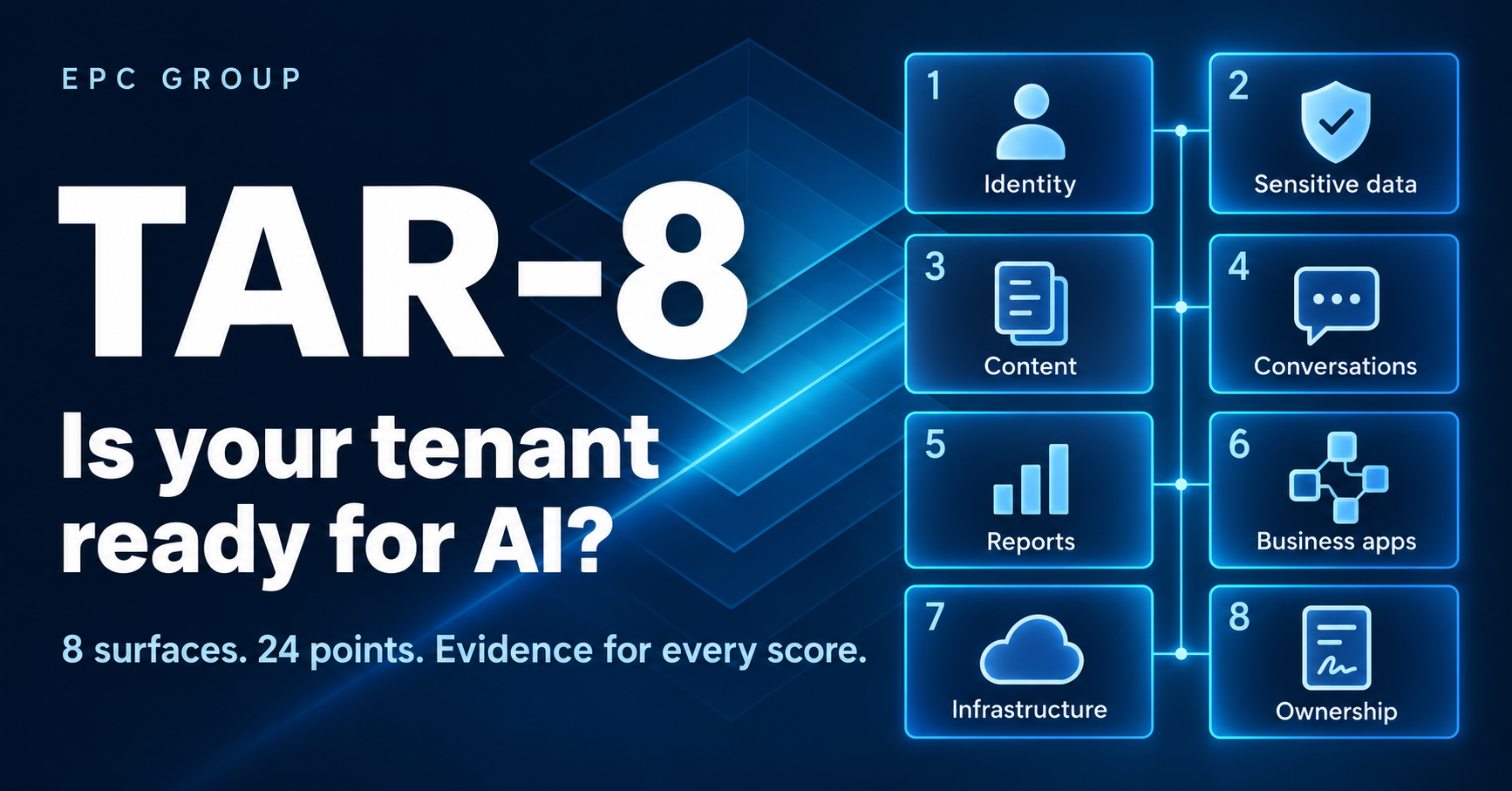
EPC Group’s open, 24-point rubric ties eight tenant surfaces to Microsoft controls and evidence for Copilot, agents, and governed external AI models.
HOUSTON, TX, UNITED STATES, September 23, 2026 /EINPresswire.com/ — EPC Group today announced the public availability of its 8-Surface Tenant AI Readiness Standard (TAR-8), an EPC Group-authored method for assessing whether a Microsoft 365 and Azure environment is prepared for Microsoft Copilot, AI agents, and approved external AI models.
The open standard defines eight connected areas of a tenant, scores each from 0 to 3, and identifies the operational evidence needed to support each score. The complete rubric, interactive self-assessment, control-to-evidence mapping, and implementation references are available on EPC Group’s TAR-8 standard page.
TAR-8 addresses a decision that a license report alone cannot answer: What can an AI system actually find, return, change, retain, or transmit once it is connected to enterprise data? Microsoft’s Copilot readiness report helps administrators identify technically eligible users and plan license assignment and adoption. EPC Group’s framework examines the underlying tenant controls and records that a chief information officer, security leader, or compliance team needs to evaluate before expanding an AI deployment.
The distinction matters because an AI deployment does not create its own identity, data classification, permission model, conversation history, analytics layer, or business process. It depends on the systems already in place. A user’s existing permissions may govern what Microsoft 365 Copilot can retrieve. An agent may also have connectors and actions that can change business records.
A separately integrated external model introduces additional questions about what context is transmitted, where it is processed, how it is logged, and whether responses are handled under the organization’s policies. TAR-8 makes those questions visible in one tenant-level assessment. The particular surfaces involved depend on the product, task, and integration.
“A Copilot license tells you who can use a tool. It does not tell you whether a Teams transcript is governed, a Power BI answer rests on a trusted model, or an agent can change a customer record,” said Errin O’Connor, Founder and Chief AI Architect of EPC Group. “TAR-8 asks for the control behind each decision and the evidence that the control operated. That is how a readiness conversation becomes an accountable deployment plan.”
EIGHT SURFACES, ONE ASSESSMENT
Identity. EPC Group examines the people, guests, workloads, and agents that can request information or take action. The review looks at Microsoft Entra ID, Conditional Access, privileged access, app consent, and the identities assigned to agents. The central question is whether every relevant action can be attributed to a known identity with appropriate scope and ownership.
Evidence can include policy exports, sign-in records, and a current agent inventory.
Sensitive data. The review checks whether Microsoft Purview sensitivity labels, data loss prevention rules, and retention settings are configured for the AI workflows actually in use.
A label applied to a document is one part of the answer; the assessment also examines whether a control operates when information is used in a prompt, grounding request, or response where the relevant product supports that control. Evidence can include label coverage, DLP policy exports, and activity reports.
Content estate. SharePoint sites, OneDrive files, and Exchange mailboxes form much of the information an employee or assistant may be permitted to access. TAR-8 asks whether external sharing, broad links, inherited permissions, stale content, and delegated access have been inventoried and reviewed before a wider Copilot rollout. A permissions inventory, SharePoint data access governance report, and a remediation record can support the score. Restricted discovery measures may contain exposure during remediation, but they do not replace correcting access rights.
Conversations. Microsoft Teams chats, meeting transcripts, recordings, and recaps can hold business decisions and sensitive information that never appeared in a formal document. The standard asks who can view those records, which meeting and retention policies apply, and whether the organization can prove how conversation data is governed. Evidence may include Teams policy exports, retention configurations, and access records.
Reports and dashboards. Power BI semantic models and Microsoft Fabric data products can become sources for AI-generated business answers. TAR-8 asks whether important models have named owners, endorsed definitions, tested row-level security, and traceable lineage. A polished dashboard does not by itself establish that an agent will use the right metric or answer within a user’s authorized scope. An endorsed-model inventory, access test, and lineage export can demonstrate the intended controls.
Business applications and customer records. In Dynamics 365, Dataverse, Power Platform, and Copilot Studio, an agent can do more than summarize information: it may update a record, trigger a workflow, or communicate with a customer. This surface tests the agent’s identity and permissions, connector policies, action logging, and any required human approval. Evidence includes an agent register, policy configuration, approval-flow definition, and action audit trail.
Infrastructure and external models. Organizations using Azure and Microsoft Foundry, or connecting approved models such as Claude, ChatGPT, Gemini, and private models to tenant data, must evaluate the entire integration path.
TAR-8 asks how identity and access are checked at retrieval, what information is transmitted to the selected service, what network and data handling controls apply, and what is recorded for later review. A third-party model does not automatically inherit Microsoft 365 permissions, labels, or retention rules; each integration has to be designed and tested for those boundaries.
Ownership and evidence:
A control with no owner or review cadence can drift after the initial rollout. The eighth surface identifies decision makers, agent sponsors, exceptions, review intervals, and the records that demonstrate continuing oversight. It connects technical findings to a governance register and a repeatable executive review, including EPC Group’s virtual Chief AI Officer service when clients need ongoing ownership.
HOW THE 24-POINT SCORE WORKS
Each surface receives 0 for unknown, 1 for inventoried, 2 for controlled, or 3 for evidenced. Across eight surfaces, the maximum is 24 points. At level 1, an organization has a dated inventory and a named owner. At level 2, the relevant control is configured and active, with exceptions documented. Level 3 calls for recent operating evidence, such as an audit log, report, tested access record, or policy export reviewed by the responsible owner. The published TAR-8 rubric describes the expected artifact for each surface.
The total is a starting point, not a pass certificate. Under EPC Group’s published gates, any surface scored 0 means the tenant is not ready under the standard regardless of its aggregate number. Identity, sensitive data, and content must each reach at least 2 before Copilot is enabled broadly. Conversations, reports, and business applications must each reach at least 2 before agents are permitted to take actions. Infrastructure and external models must reach at least 2 before an external model is connected to tenant data. Ownership and evidence are reviewed quarterly. A high total cannot erase a missing prerequisite.
Consider an organization with enough eligible licenses to start a Copilot rollout. If its SharePoint estate contains broadly accessible financial files and nobody has reviewed those permissions, TAR-8 directs the team to address the content surface before expanding access. If a sales agent is being considered, the assessment adds agent identity, connector restrictions, approval points, and the record of what the agent changed.
If a company wants an outside model to analyze approved documents, it must test the governed retrieval and transmission path rather than assume Microsoft 365’s controls automatically follow the text to another platform. These are illustrative scenarios, not claims about a particular client tenant.
FROM A PUBLISHED RUBRIC TO A READ-ONLY REVIEW
Organizations can use the free interactive scorecard on the TAR-8 page to record an initial view of their eight surfaces and copy a shareable score link. Self-scoring helps start the discussion; it is not a substitute for examining tenant exports and validating controls. EPC Group also offers a scoped Tenant AI Readiness Assessment that applies the rubric to an organization’s environment. The review is read-only: it examines reports and exports and does not change tenant settings. Its scope is confirmed after a discovery discussion based on the tenant, integrations, regulatory obligations, and evidence already available.
The assessment produces three concrete outputs:
– First, a surface-by-surface score records what is known, controlled, and evidenced and calls out any deployment gate that has not been met.
– Second, a prioritized remediation sequence identifies which exposures to contain now, which permissions or policies to correct, and which safeguards should prevent the same issue from returning.
– Third, an evidence pack organizes the dated, owned artifacts for security, executive, audit, or insurer review. The pack supports those stakeholders’ evaluation; TAR-8 itself is not an external audit, regulatory approval, or certification.
The process creates practical entry points for several EPC Group practices. Identity findings can lead to Entra and Conditional Access work. Sensitive-data findings can lead to Purview classification and DLP. Content and conversation findings connect to SharePoint, Microsoft 365, and Teams governance.
Analytics findings can drive Power BI semantic-model review and Microsoft Fabric data governance. Action-taking agents raise Dynamics 365, Dataverse, Power Platform, Copilot Studio, and approval-design questions. External-model findings lead to Azure and Microsoft Foundry architecture.
findings can be carried into an ongoing AI governance or virtual Chief AI Officer engagement. Each follow-on project can be scoped from an identified gap and its required evidence rather than from a generic AI product list. | EPC Group’s VCAIO Offering: https://www.epcgroup.net/services/vcaio
An organization that needs a narrower first step can focus on the identity, sensitive-data, and content prerequisites for a broad Copilot deployment. A team already using agents can assess action permissions, connector paths, analytics, and audit records. An enterprise working across several model providers can examine whether every approved path into Microsoft 365 data preserves the specific controls its architecture requires. The eight-surface standard keeps the resulting work connected even when different teams own its parts.
The public standard also maps its surfaces to Microsoft controls, the NIST AI Risk Management Framework, and ISO/IEC 42001 concepts. These mappings help buyers trace a governance objective to a configured control and then to an artifact that can be examined. Mapping a control to a framework does not confer ISO certification or establish that an organization complies with every applicable requirement. EPC Group identifies TAR-8 as its own published assessment standard, not as a Microsoft program or independent accreditation. Its page records the current version as v1.0.1 and states a 90-day Microsoft documentation review schedule.
“The score matters because it forces the next question: show me the report, export, or log,” O’Connor added. “If we can show what the agent is allowed to do, which data it can reach, who owns the decision, and what happened when it ran, leadership can decide what to launch next and what to fix first.”
EPC Group developed the standard from work spanning Microsoft 365 governance, SharePoint permissions, Copilot preparation, Power BI and Fabric data architecture, Azure, and enterprise AI controls. The firm reports more than 300 Copilot initiatives and 300 AI implementations. Its publicly available Evidence Center documents its broader delivery record and Microsoft partnership information.
For a chief information officer or security team evaluating an AI rollout, the published rubric offers a way to challenge a broad statement such as “we are Copilot-ready” with eight specific control and evidence questions. Readers can review the TAR-8 article and its interactive scorecard at: https://www.epcgroup.net/insights/microsoft-365-tenant-ai-readiness-8-surface-standard.
– To discuss a scoped eight-surface review, request a conversation with a senior EPC Group architect at https://www.epcgroup.net/contact
– EPC Group’s public delivery and partner information appears in the EPC Group Evidence Center at https://www.epcgroup.net/evidence-center
ABOUT EPC GROUP
Email EPC Group today at contact@epcgroup.net.
EPC Group, the trade name of O’Connor Enterprise Group, Inc., is a Houston-based Microsoft consulting firm founded in 1997. The firm reports more than 11,000 enterprise engagements, including 6,500+ SharePoint implementations, 1,500+ Power BI deployments, and 500+ Microsoft Fabric projects.
EPC Group holds all six Microsoft Solutions Partner designations and works across Microsoft 365, Copilot, SharePoint, Power BI, Fabric, Azure, AI governance, and tenant migrations. Founder Errin O’Connor is a Microsoft Press and Sams/Pearson author. Learn more at https://www.epcgroup.net
Michelle Stevens
EPC Group
+1 888-381-9725
email us here
Visit us on social media:
LinkedIn
Bluesky
Instagram
Facebook
YouTube
TikTok
X
Other
Why Clients Trust EPC Group: 7 Quarters of G2 Leader Recognition
Legal Disclaimer:
EIN Presswire provides this news content “as is” without warranty of any kind. We do not accept any responsibility or liability
for the accuracy, content, images, videos, licenses, completeness, legality, or reliability of the information contained in this
article. If you have any complaints or copyright issues related to this article, kindly contact the author above.

Media gallery