Front-of-pack nutrition initiatives, premium nutrition positioning and Asia-Pacific expansion are creating new opportunities across the global cereal industry.
NEW YORK, NY, UNITED STATES, August 25, 2026 /EINPresswire.com/ — The global Breakfast Cereals Market is entering a sustained period of transformation as consumers, manufacturers and retailers respond to changing nutrition expectations, convenience-driven lifestyles, digital grocery adoption and evolving food-labeling requirements.
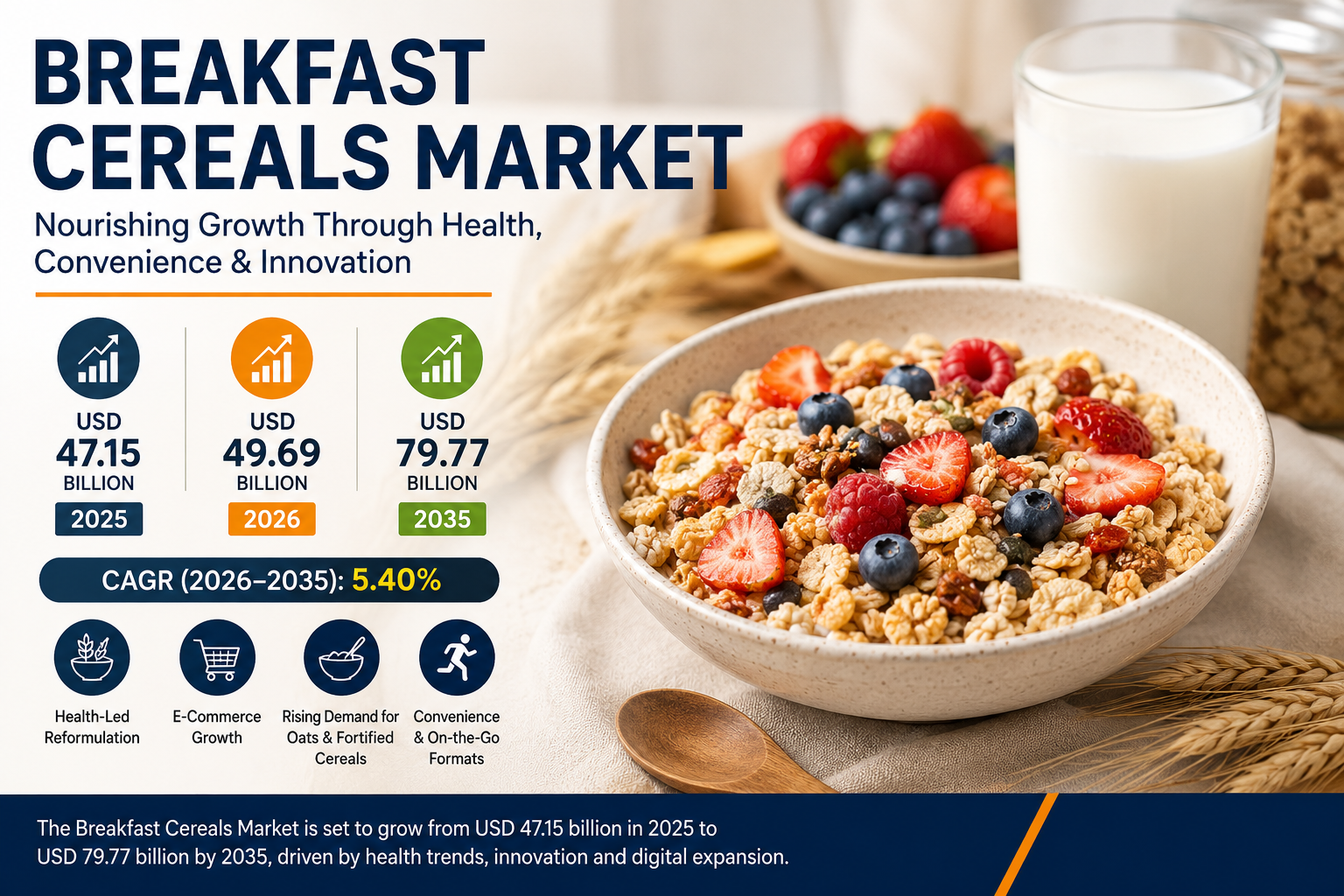
According to Market Research Future, the global Breakfast Cereals Market was valued at USD 47.15 billion in 2025 and is projected to reach USD 49.69 billion in 2026, before expanding to USD 79.77 billion by 2035, representing a 5.40% compound annual growth rate (CAGR) during the forecast period.
The outlook reflects more than incremental category expansion. Breakfast cereals are being repositioned from a conventional morning staple into a broader portfolio of convenient, nutrition-oriented and increasingly portable food formats. Manufacturers are responding with lower-sugar recipes, whole-grain and oat-based formulations, fortified products, single-serve packaging, online-first distribution strategies and products designed for consumption beyond the traditional breakfast occasion.
Health and Reformulation Move to the Center of Category Strategy
One of the most important structural forces affecting the Breakfast Cereals Market is the growing influence of nutrition expectations and food-labeling policy.
The market research identifies health-led reformulation and sugar reduction as a major growth driver. Manufacturers are increasingly adjusting recipes to address consumer demand for improved nutritional profiles while also preparing for regulatory requirements surrounding the disclosure and presentation of nutritional information.
In the United States, the U.S. Food and Drug Administration’s proposed front-of-package nutrition labeling initiative has added further momentum to the reformulation discussion. The proposed framework would place prominent nutrition information on the front of many packaged foods, increasing the strategic importance of sugar, saturated fat and sodium levels in product development and packaging decisions.
For cereal manufacturers, reformulation is therefore becoming both a compliance consideration and a commercial opportunity. Products that combine reduced sugar with whole grains, fiber, protein, vitamins and minerals can potentially command stronger consumer attention and support premium positioning.
The category is also seeing a shift away from relying exclusively on traditional brand recognition. Nutrition credentials, ingredient transparency and recognizable grain sources are increasingly becoming part of the value proposition.
Get Full PDF Sample Copy of Report: (Including Full TOC, List of Tables & Figures, Chart) @ https://www.marketresearchfuture.com/sample_request/2202
Convenience Formats Expand the Addressable Market
Modern consumers are increasingly balancing work, commuting, education, family responsibilities and irregular schedules, creating demand for breakfast products that require minimal preparation.
This trend is supporting cups, sachets, portable clusters, individual portions and other on-the-go cereal formats. According to the MRFR market analysis, cups and on-the-go packaging are projected to expand at a 10.10% CAGR from 2026 to 2035, making the format one of the fastest-growing areas within cereal packaging.
Convenience also allows cereals to compete for consumption occasions outside the conventional breakfast window. Portable cereals can increasingly function as snacks, afternoon refreshments, workplace foods and convenient meal components.
This broadening of consumption occasions gives manufacturers additional opportunities to increase purchase frequency without relying solely on household breakfast penetration.
Oats Gain Momentum as Nutrition Positioning Strengthens
Ingredient trends are also reshaping competition.
Corn remains the leading ingredient source, accounting for approximately 33.9% of 2025 revenue, while wheat represents another significant portion of the market. However, oat-based products are gaining momentum and are projected to grow at approximately 6.70% CAGR during 2026–2035. Rice-based products generated approximately USD 5.80 billion in 2025, according to the market analysis.
Oats benefit from their association with fiber, satiety and heart-health-oriented nutrition. The ingredient also provides manufacturers with a platform for developing granola, muesli, porridge, instant oatmeal and ready-to-cook products.
The market’s expansion beyond conventional corn flakes and wheat-based products is creating opportunities for other grains as well. Millet, sorghum, buckwheat and other ancient or alternative grains can provide differentiated nutritional, sustainability and dietary positioning.
This creates room for manufacturers to develop localized cereal portfolios rather than relying on standardized global recipes.
Ready-to-Eat Products Continue to Dominate
Ready-to-eat cereals accounted for approximately 69.4% of the market in 2025, supported by their convenience, long shelf life, efficient distribution and established consumer familiarity. At the same time, ready-to-cook cereals are projected to grow at approximately 6.15% CAGR through 2035.
The contrast between the two segments highlights an important feature of the evolving market.
Ready-to-eat cereals benefit from scale and established retail infrastructure, while ready-to-cook formats are benefiting from the growing popularity of oats, porridge and hot cereal products. Instant sachets and portion-controlled formats have reduced preparation barriers and expanded the relevance of ready-to-cook products for consumers seeking healthier breakfast alternatives.
E-Commerce and Quick Commerce Reshape Cereal Distribution
Digital grocery is becoming increasingly important to the Breakfast Cereals Market.
Online retailers are identified as the fastest-growing distribution channel, with the segment projected to advance at approximately 11.60% CAGR through 2035.
E-commerce offers cereal manufacturers several strategic advantages. Digital shelves can accommodate a wider assortment than physical stores, enabling smaller brands to introduce specialized products without immediately requiring national supermarket distribution.
Quick-commerce platforms also allow emerging brands to reach consumers in urban markets through rapid delivery and digital merchandising.
In markets such as India, this trend is particularly significant. Growing urban populations, increasing digital grocery penetration and demand for convenient food options are creating an environment in which oats, muesli, granola and functional cereal products can gain visibility without depending entirely on traditional retail shelf expansion.
Digital channels can additionally generate first-party consumer data, allowing manufacturers to monitor repeat purchasing, product preferences and responses to new formulations.
Asia-Pacific Emerges as a Major Growth Engine
Regional dynamics are expected to become increasingly important over the forecast period.
North America remains a major market, contributing approximately USD 15.94 billion in 2025, while Asia-Pacific is projected to grow at approximately 6.55% annually through 2035, above the overall global CAGR.
The Asia-Pacific opportunity is being supported by urbanization, income growth, changing household structures, expanding modern retail and accelerating e-commerce adoption.
India is identified as a particularly important growth market, with the Breakfast Cereals Market projected to grow at approximately 8.15% CAGR. Demand for oats and muesli, changing urban breakfast habits and rapid-commerce distribution are helping expand the category.
China, Japan, South Korea and ASEAN markets also contribute to the region’s expanding opportunity, although consumer preferences vary significantly across countries.
Localization is consequently becoming essential. Manufacturers entering Asia-Pacific cannot necessarily rely on Western flavor profiles or standardized product formats. Regional grains, local flavors, familiar textures and culturally relevant serving occasions can provide stronger pathways to consumer adoption.
North America Remains a High-Value Market
North America represented approximately 33.8% of the global market in 2025, making it one of the industry’s most important revenue centers. The region is characterized by mature distribution networks, strong brand recognition and increasing demand for nutrition-oriented innovation.
The United States remains the dominant market within the region, accounting for approximately 79.5% of regional demand, according to the MRFR analysis.
However, mature-market growth comes with competitive pressure. Consumers have increasingly diversified breakfast choices, with yogurt, protein beverages, breakfast bars and foodservice competing for the same consumption occasion.
Cereal manufacturers are therefore using reformulation, portion control, functional nutrition and snack-oriented product development to defend category relevance.
Europe Rewards Clean-Label and Private-Label Strategies
Europe represents another mature but evolving cereal market.
The regional market is characterized by strong interest in whole grains, organic products, clean-label formulations and private-label offerings. Regulatory restrictions affecting the marketing and placement of foods high in fat, salt and sugar have also encouraged manufacturers to rethink formulation and product positioning.
Private label presents both a challenge and an opportunity. Branded manufacturers face increased competition from retailer-owned products, while cereal producers with available manufacturing capacity can pursue contract manufacturing opportunities.
This dynamic may support consolidation and strategic partnerships as manufacturers seek to improve plant utilization and protect margins.
Packaging Innovation Creates New Growth Opportunities
Packaging is becoming an increasingly important competitive differentiator.
Traditional boxes accounted for approximately 60.2% of the market in 2025, while stand-up pouches represented about 24.6%. Cups and on-the-go formats are growing more rapidly as consumers prioritize portability and portion control.
The shift toward smaller formats also changes the economics of the category.
Single-serving packages can support convenience premiums while allowing brands to target workplaces, travel, schools, fitness occasions and impulse purchases. Meanwhile, pouches can provide material and freight efficiencies compared with conventional rigid packaging.
Sustainability considerations are likely to become increasingly important as manufacturers balance shelf stability, protection, recyclability and packaging cost.
Fortification and Functional Nutrition Expand Product Potential
Breakfast cereals have long provided a platform for vitamins and minerals, but fortification is becoming increasingly relevant to emerging markets and nutrition-conscious consumers.
Iron, folate and B-vitamin fortification can support cereal adoption in markets where public-health nutrition programs and staple-food fortification have already established consumer familiarity.
At the premium end of the market, manufacturers are exploring protein, fiber and other functional nutrition claims to distinguish products from conventional cereals.
The result is a broader competitive landscape in which cereal products can increasingly compete with functional foods rather than only with other cereal brands.
Competition and Industry Consolidation
The global Breakfast Cereals Market remains moderately concentrated, with major multinational manufacturers competing alongside private-label producers, regional brands and specialist health-focused companies.
Companies identified in the market landscape include General Mills, Nestlé through Cereal Partners Worldwide, WK Kellogg Co, Kellanova, Post Holdings, PepsiCo through Quaker Oats, Nature’s Path Foods, Bob’s Red Mill, Marico, Bagrry’s India, Dr. Oetker and Hain Celestial, among others.
Industry ownership changes and portfolio consolidation are adding another layer to competitive strategy.
The separation of WK Kellogg Co from Kellanova and subsequent ownership developments have highlighted the continuing strategic value of established cereal brands, manufacturing infrastructure and retail relationships.
For investors and strategic buyers, the market’s relatively stable underlying demand, established brand equity and opportunities for reformulation provide potential value-creation pathways.
Emerging Opportunities Beyond Traditional Breakfast
The future of cereal is increasingly extending beyond the breakfast table.
Evening snacking, sports-oriented nutrition, convenient workplace consumption and dessert-adjacent applications offer manufacturers opportunities to reposition existing products for additional consumption occasions.
This expansion can be supported by modular formulations combining cereals with protein, fiber, seeds, dried fruit and other ingredients.
Subscription-based models may further strengthen repeat purchasing, particularly for households with predictable consumption patterns.
The convergence of digital retail, personalized nutrition and flexible packaging could eventually support smaller, more specialized cereal product portfolios alongside traditional mass-market brands.
Sustainability Enters the Supply Chain Equation
Sustainability is becoming increasingly relevant to cereal production because grains sit at the center of agricultural sourcing and food manufacturing.
Manufacturers are facing growing pressure to understand the environmental impact of grain procurement, processing and packaging. Regenerative agriculture initiatives, traceable sourcing and emissions measurement can increasingly influence supplier selection and long-term procurement agreements.
Energy efficiency is another consideration. Cereal extrusion and drying processes can be energy-intensive, encouraging producers to explore heat recovery, electrification and more efficient production systems.
Over time, operational efficiency may become an increasingly important differentiator in a category where volume growth is steady but not explosive.
Market Outlook Through 2035
The Breakfast Cereals Market is positioned for steady expansion through 2035, supported by the intersection of convenience, nutrition, digital distribution and product innovation.
The market’s projected rise from USD 47.15 billion in 2025 to USD 79.77 billion by 2035 represents an increase of more than USD 32 billion in market value. At a 5.40% CAGR, the category is expected to generate sustained opportunities for established manufacturers, emerging brands, ingredient suppliers, packaging companies, retailers and investors.
The strongest opportunities are likely to emerge where several consumer trends intersect: healthier formulations that remain convenient, products built around oats and other nutrient-dense grains, portable formats, digitally enabled distribution, localized flavors and fortification.
Rather than disappearing as consumers diversify their breakfast choices, cereal is evolving.
The category is moving from a standardized box-on-the-shelf model toward a more fragmented ecosystem of nutrition-focused, convenient and digitally distributed products. Manufacturers capable of balancing affordability, taste, nutritional credibility and operational efficiency will be best positioned to participate in the next phase of market development.
As regulatory expectations continue to evolve and consumer demand shifts toward transparency and functional nutrition, reformulation will remain a central industry theme. At the same time, emerging markets — particularly across Asia-Pacific — are expected to provide an important source of incremental volume.
The result is a Breakfast Cereals Market that combines the stability of an established global food category with significant room for innovation.
Discover Related Research Reports By Market Research Future:
Malted Wheat Flour Market
https://www.marketresearchfuture.com/reports/malted-wheat-flour-market-42139
Corn Starch Market
https://www.marketresearchfuture.com/reports/corn-starch-market-7485
Oat Based Snacks Market
https://www.marketresearchfuture.com/reports/oat-based-snacks-market-27437
Market Research Future
Market Research Future
+1 855-661-4441
email us here
Legal Disclaimer:
EIN Presswire provides this news content “as is” without warranty of any kind. We do not accept any responsibility or liability
for the accuracy, content, images, videos, licenses, completeness, legality, or reliability of the information contained in this
article. If you have any complaints or copyright issues related to this article, kindly contact the author above.

Media gallery