
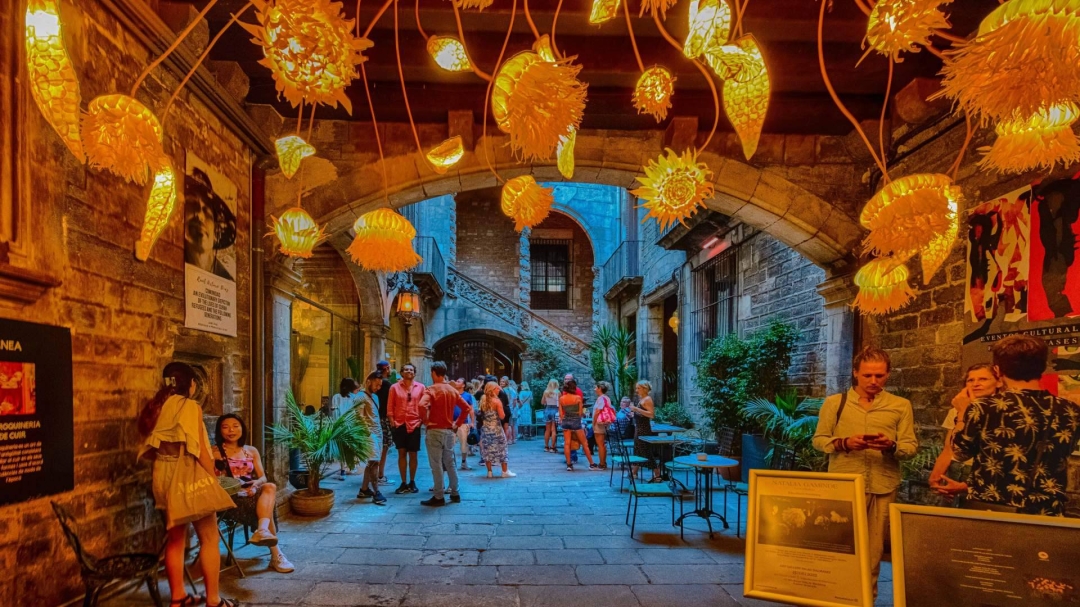
Barcelona is one of those cities that rewards the traveler who slows down. Yes, the Sagrada Família is extraordinary. Yes, Park Güell deserves its reputation. But the city’s real magic lives in its neighborhoods — in the smell of old stone and jasmine at dusk, in a glass of cold vermouth on a sun-warmed plaza, in a photograph you didn’t expect to take. Here are five experiences that go beyond the standard itinerary.
· El Born & the Mercat de Santa Caterina
Forget La Boqueria. The real market experience in Barcelona is at the Mercat de Santa Caterina, in the medieval neighborhood of El Born — and most tourists walk right past it. Its roof is a breathtaking mosaic of 325,000 ceramic tiles in dozens of colors, designed by Enric Miralles and completed posthumously by his wife. Beneath it, locals actually shop. No performance, no selfie sticks, just a neighborhood doing what it has done for centuries.
El Born itself is the kind of neighborhood that makes you want to put your phone away and simply walk. Narrow streets open without warning onto broad plazas. The Basílica de Santa Maria del Mar — built by the people of the Ribera quarter in the 14th century, stone by stone — stands as one of the purest examples of Catalan Gothic architecture in existence. And at its feet: terraces, bookshops, and the particular Barcelona light that photographers travel the world to find.
For those who want to capture it properly, the El Born Photography Tour by PhotoTour Barcelona covers the neighborhood’s best corners with a professional photographer who knows where the light falls at every hour of the day — from the medieval alleyways to the facade of Santa Maria del Mar at dawn.
Photographer’s tip: The side streets around Santa Maria del Mar between 7 and 9am are extraordinary — raking light, no crowds, wet cobblestones catching the sky. The Mercat de Santa Caterina’s mosaic roof photographs best from across Avinguda de Francesc Cambó in the late morning.
· Vermouth Hour in Gràcia, Away from the tourist circuit
The neighborhood of Gràcia was an independent municipality until 1897, and it has never quite forgiven the annexation. It still operates like a village — with its own fierce identity, its own festivals, and its own Sunday ritual: la hora del vermut.
On a Sunday around noon, the plazas of Gràcia — Plaça del Sol, Plaça de la Vila de Gràcia, Plaça de la Virreina — fill with locals drinking small glasses of cold vermouth with olives and chips, talking unhurriedly about nothing in particular. There is no performance here for tourists. You simply pull up a chair, order a vermut, and become temporarily, wonderfully local.
Ask for a house vermouth — most bars in Gràcia pour their own, from unmarked bottles kept behind the bar. Pair it with boquerones (anchovies in vinegar) and you’ll understand why Barcelonans don’t hurry lunch.
· Bunkers del Carmel at Sunset — and the story behind them
Everyone knows the view from Park Güell. Fewer people know about the Turó de la Rovira, the hilltop above the Carmel neighborhood where crumbling concrete anti-aircraft platforms offer the most complete panorama of Barcelona — from the sea to the mountains, from Tibidabo to the towers of the Sagrada Família catching the last orange light of the day.
These aren’t picturesque ruins. They were built in 1937 during the Spanish Civil War to defend the city from Franco’s bombers. After the war, a shantytown of displaced families grew up around them — people who lived here without water or electricity until the 1990s. The city has since reclaimed the space as a mirador, but the history is in the concrete if you know where to look. Come at sunset with a bottle of cava and you’ll understand why this is where Barcelonans themselves come when they need to see their city whole.
Photographer’s tip: Arrive 45 minutes before sunset. The city lights begin to warm just as the sky turns — the 20-minute window when both are balanced is one of Barcelona’s great photographic moments.
· The Palau de la Música — A concert, not a tour
Lluís Domènech i Montaner’s Palau de la Música Catalana is one of the most photographed facades in Barcelona. Millions pass by it every year; far fewer actually go inside — and fewer still do so the right way, which is: at night, for a concert, when the stained-glass ceiling pours colored light down onto the musicians and the building finally becomes what it was always meant to be.
The Palau programs concerts year-round, ranging from Catalan folk music and flamenco to jazz and classical. Tickets for many performances cost less than a museum entry. Sit beneath that extraordinary explosion of glass and light and hear music fill a room designed to amplify it, and you’ll understand that some buildings are only half-alive when they’re empty.
· A guided photo walk with a professional photographer
Barcelona is a city that reveals itself slowly, and the best guide isn’t a headset tour or a downloaded audio walk — it’s a person who has spent years photographing Barcelona’s streets and knows not just where to stand, but why that particular doorway was built in 1382, which filmmaker used this alley as a location, and how the light changes on this corner between 7am and noon.
PhotoTour Barcelona offers guided photo walks through the city’s most photogenic neighborhoods — El Born, the Gothic Quarter, Modernisme routes, Montjuïc, nocturnal Barcelona — led by a professional photographer who combines technical photography coaching with the kind of local storytelling that turns a good walk into an unforgettable one. Tours run in small groups or private format, in English, for all levels and all cameras — including smartphones.
This is the rare souvenir that money can’t buy off a shelf: a photograph you took yourself, in a city you truly understood, guided by someone who loves it as much as you’re beginning to.
Come to Barcelona this summer and experience the city like never before. Whether you’re drawn to medieval alleyways, Modernist masterpieces, or the golden hour over the Mediterranean, PhotoTour Barcelona will show you how to find it — and how to take it home. Book your tour or get in touch today.
Frequently asked questions
What are the best non-touristy things to do in Barcelona?
Some of the best local experiences in Barcelona include the Mercat de Santa Caterina in El Born, Sunday vermouth hour in the plazas of Gràcia, sunset at the Bunkers del Carmel (Turó de la Rovira), a live concert at the Palau de la Música Catalana, and a guided photo walk with a professional photographer through neighborhoods like El Born and the Gothic Quarter.
Is the Mercat de Santa Caterina better than La Boqueria?
For an authentic market experience, yes. La Boqueria is heavily touristed, while the Mercat de Santa Caterina — with its famous mosaic roof of 325,000 ceramic tiles designed by Enric Miralles — is where locals in El Born actually shop, just steps from the Basílica de Santa Maria del Mar.
What is vermouth hour (“la hora del vermut”) in Barcelona?
It is a beloved local ritual, especially on Sundays around noon, when Barcelonans gather in neighborhood plazas — particularly in Gràcia — to drink small glasses of cold house vermouth with olives, chips, and boquerones before lunch.
What are the Bunkers del Carmel and are they worth visiting?
The Bunkers del Carmel are former anti-aircraft platforms on the Turó de la Rovira hilltop, built in 1937 during the Spanish Civil War. Today they offer arguably the best 360° panoramic view of Barcelona. The best time to visit is about 45 minutes before sunset.
Can I take a photography tour of Barcelona if I only have a smartphone?
Yes. PhotoTour Barcelona runs guided photo walks in English through El Born, the Gothic Quarter, Modernisme routes, Montjuïc, and nocturnal Barcelona, led by a professional photographer, in small groups or private format, for all skill levels and all cameras — including smartphones.
Is it worth going inside the Palau de la Música Catalana?
Yes — but the best way is to attend an evening concert rather than a daytime tour. Concerts run year-round and many tickets cost less than a museum entry, letting you experience the stained-glass ceiling as the building was designed to be experienced.
Come to Barcelona this summer and experience the city like never before…
Media Contact
Company Name: Photo Tour de Barcelona
Contact Person: Press Office
Email: Send Email
Country: United States
Website: https://www.phototourbarcelona.com/en/photography-tour-el-born-barcelona/


