TrustPlus AI shows how AI workflow automation can accelerate credit underwriting, strengthen merchant risk monitoring and improve financial risk governance
SINGAPORE, SINGAPORE, SINGAPORE, June 5, 2026 /EINPresswire.com/ — Artificial intelligence in financial services is entering a more practical phase. After years of pilots involving chatbots, analytics dashboards and narrow automation tools, financial institutions are beginning to apply AI to the workflows that determine how risk is assessed, approved and monitored.
One of the clearest examples is commercial credit underwriting. For banks, payment companies, fintech lenders, credit insurers and private credit funds, underwriting remains highly manual. Analysts collect documents, spread financial statements, research companies, review adverse media and prepare credit memos before senior risk officers can make decisions. In many institutions, that process still depends on spreadsheets, PDFs, manual web research and fragmented internal systems.
The challenge is not a lack of data. Financial institutions already have financial statements, transaction data, web activity, corporate filings, sanctions and compliance sources, industry intelligence and portfolio indicators. The harder problem is converting that fragmented information into consistent, explainable and timely credit judgment.
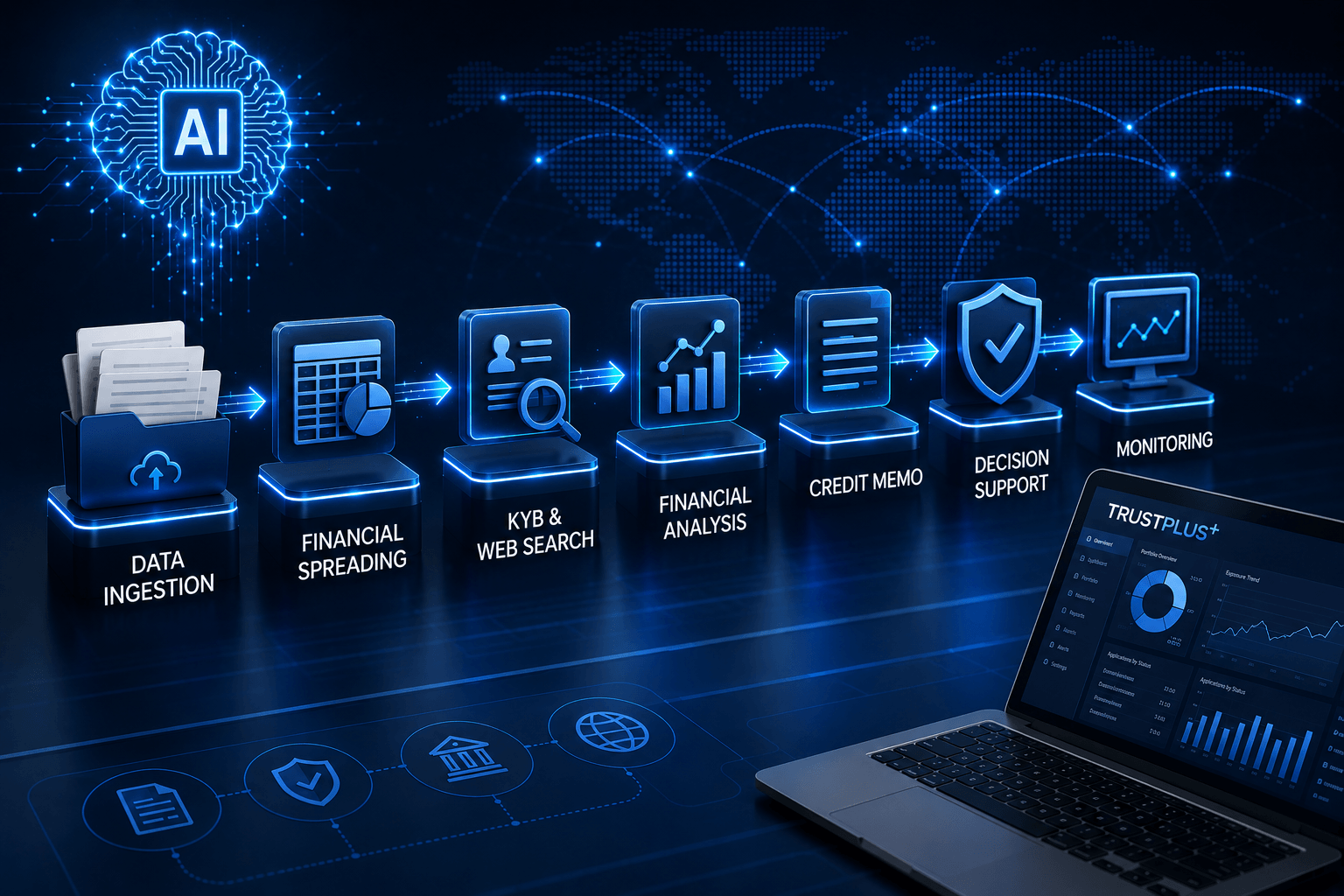
That is why AI adoption is moving beyond point solutions and toward workflow automation. Rather than producing a single score or summary, the next generation of systems is expected to support the full underwriting lifecycle: data ingestion, financial spreading, KYB checks, business analysis, credit memo preparation, decision support and ongoing monitoring.
This shift is especially relevant in payments. Merchant underwriting is no longer only a question of whether a business appears financially viable at onboarding. Payment companies and acquirers must also understand what merchants sell, whether activity matches the declared business model and whether a merchant could create card scheme, compliance or reputational risk.
Card network compliance creates a practical challenge: merchant risk is dynamic. A merchant approved today may change its website tomorrow, add new products, redirect traffic, shift into a higher-risk category or display content that creates potential scheme violation concerns. Manual reviews cannot easily keep pace with that level of change across large merchant portfolios.
AI-enabled merchant web intelligence is emerging as a response. By continuously reviewing merchant websites, product pages, business descriptions, adverse media and other public signals, payment companies can identify changes that may indicate emerging compliance or scheme risk. The goal is to help compliance teams prioritize merchants and behaviors that require closer review.
TrustPlus AI is one example of this broader market movement. The Singapore-headquartered credit technology company provides AI-powered workflow solutions for commercial credit underwriting, portfolio monitoring and merchant web intelligence. Its platform automates financial spreading, KYB, credit research, financial analysis, credit memo generation and monitoring, while keeping human experts responsible for review, judgment and approval. TrustPlus AI is already serving global payment companies, including one of the world’s largest payment platforms, where enterprise-scale underwriting and monitoring require speed, consistency and strong governance.
The company’s positioning reflects a wider realization in the industry: the value of AI is not simply speed, but the ability to redirect expert attention toward higher-quality judgment. If AI can handle repetitive preparation work, risk professionals can spend more time assessing business models, exceptions, early warning indicators and portfolio-level exposure.
TrustPlus AI says its platform has demonstrated a 5–10x increase in review processing speed, a 3x acceleration in time to revenue and an estimated 30% reduction in credit losses based on client deployments. The company also states that underwriting processing time can be reduced from more than 24 hours to under three hours.
The same workflow logic can extend from credit underwriting into merchant monitoring. For payment companies, the underwriting file and the merchant website are increasingly connected. A merchant’s financial profile, business model, public presence, website content and transaction behavior all contribute to risk assessment. AI systems that connect these signals may help payment companies detect inconsistencies earlier and manage exposure more effectively.
This is particularly important for card scheme compliance. Scheme violations are not always visible through transaction data alone. Some risks emerge from what a merchant offers online, how products are described, whether prohibited categories appear, or whether a merchant’s actual activity diverges from its approved profile. A more intelligent monitoring layer can help acquirers and payment companies identify issues before they become regulatory, financial or reputational problems.
Adoption, however, depends on trust. AI systems used in credit and payments risk must be explainable, auditable and governed. Institutions need to know what data was used, what the system identified, how a conclusion was reached and what a human reviewer changed or approved. In regulated environments, black-box automation is unlikely to be accepted.
The next phase of AI in credit and payments will be defined less by model sophistication alone and more by workflow integration. The winners will be those that understand how risk teams work, how decisions are documented, how exceptions are handled and how institutions prove compliance after the fact.
The industry is moving quickly because the pressure is real. Financial institutions need to approve good business faster, control risk more consistently and monitor portfolios with fewer manual bottlenecks. Payment companies need to support merchant growth while protecting themselves from fraud, prohibited activity and card scheme violations. AI will not eliminate expert judgment, but it can change where that judgment is applied.
Kevin Lee
Plusworld Investment
email us here
Legal Disclaimer:
EIN Presswire provides this news content “as is” without warranty of any kind. We do not accept any responsibility or liability
for the accuracy, content, images, videos, licenses, completeness, legality, or reliability of the information contained in this
article. If you have any complaints or copyright issues related to this article, kindly contact the author above.

Media gallery