FIDO Inc. (CEO: Kenji Nakamura), a concept branding developer dedicated to creating innovative value in land and living spaces, has officially launched the “THE TIMELESS CONDOMINIUM” project. This initiative seeks to carry forward the intrinsic values rooted in Japan into the world 100 years from now through the form of residences.
This press release features multimedia. View the full release here: https://www.businesswire.com/news/home/20260427355247/en/
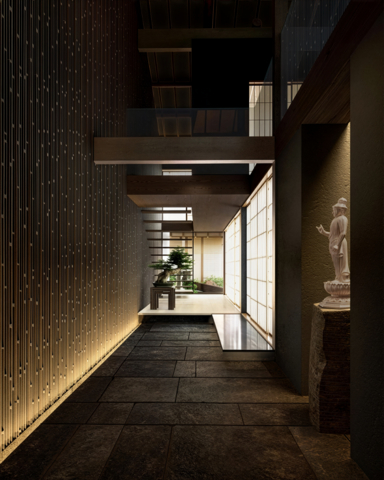
Rendering of the entrance. A sculpture from Kokei Eri will be displayed.
As its first project, the company unveils details of “THE SILENCE – Furnished by ARMANI/CASA,” a residence set within the historic former Hasegawa Residence, a 200-year-old ochaya (traditional teahouse) located in Kyoto’s Kamishichiken district.
This announcement includes the first release of information regarding the property’s key spaces, as well as profiles of the world-class master artisans, referred to as the “Masters of Foundations” who have come together for this project.
- ️A Cultural Asset Residence Created by the World’s Leading Masters
This project aims to create a “residence as a cultural asset,” transmitting Japan’s history, traditional culture, and aesthetic sensibilities to the world while preserving them for the future. The project brings together exceptional masters who have shaped Japanese culture and architecture, including: World-renowned architect Kengo Kuma as Design Supervisor, Kongō Gumi, temple carpenters responsible for construction, Nakamura Sotoji Komuten for tea room craftsmanship, Oniwa Ueji (Ogawa Jihei lineage) for landscape design. Together, they present the design philosophy, spatial concepts, and architectural expressions created exclusively for this residence.
- A One-of-a-Kind Residence Carrying Forward History in Kamishichiken
The former Hasegawa Residence, located in the heart of Kamishichiken—Japan’s oldest hanamachi district—has stood for over 200 years as a traditional tea house. This traditional wooden structure features: Kyoto’s characteristic narrow, elongated layout, Delicate sukiya-style design, Playful elements typical of an ochaya.
Rather than preserving it as-is, the project reinterprets the building through the craftsmanship and sensibilities of master artisans, transforming it into a unique residence where past, present, and future coexist seamlessly.
- Bamboo as the Symbol of “Silence” and Japanese culture
The overarching theme proposed by Kengo Kuma is “Silence,” a concept deeply suited to Kyoto and Kamishichiken. To embody this, bamboo has been adopted embodying strength, flexibility, and the beauty of space in Japan. This concept resonates with Giorgio Armani’s inspiration from the Japanese Landscapes, positioning the project at the intersection of Japanese aesthetics and global luxury.
- Kongō Gumi, the world’s oldest company, redefines space with 1,400 years of technique
Kongō Gumi, the world’s oldest company with over 1,400 years of history, restructures the complex wooden architecture. By reducing numerous structural pillars to just two, they achieve: Preservation of traditional architectural beauty, Creation of open, elegant living spaces. The design incorporates contrasts between black and white bamboo, blending tradition with modern livability. The entrance features a double-height space inspired by sukiya architecture, while stone pathways connect seamlessly from the street into the interior, creating a tranquil and immersive experience.
- Intersection of culture and luxury where ARMANI/CASA harmonizes with Japanese architecture
The meeting of master artisans who have supported Japanese traditional culture and ARMANI/CASA, which symbolizes global aesthetic sense, creates a residence unlike any in the world, where universal beauty and modern sophistication are harmonized. The living room features a large opening facing the garden, creating a design where interior and garden are unified. Within a tranquil space based on white and beige tones, the setting by ARMANI/CASA is applied to ceilings, furniture, and fabrics. Rare furniture pieces, of which only a few exist worldwide, are incorporated, realizing a space where the margin and quietness of Japanese architecture overlap with the refinement of global luxury.
- A garden that expresses a space where architecture and nature become one, allowing the experience of Japan’s four seasons
Between the main building and the detached house spreads a garden that condenses the essence of Japan’s four seasons. It is created by “Oniwa Ueji,” inheriting the lineage of Jihei Ogawa, one of Japan’s foremost garden designers. Water flowing from a stepped waterfall circulates into a pond, reflecting the transitions of nature through the four seasons, as well as the eternal flow of time that exists within this residence. Furthermore, by installing a corridor that crosses above the garden, a bold composition is introduced within stillness, creating a spatial experience where architecture and nature become one.
- A tea room that revives the spirituality of wabi-sabi, continuing from the era of Sen no Rikyu
The tea room is conceived as a space that purely embodies the spirituality of wabi-sabi. Construction is undertaken by Nakamura Sotoji Komuten, which inherits traditional construction methods that have continued since the era of Sen no Rikyu, reviving the essential value of Japanese architecture in a form suitable for the modern age. In addition, by utilizing its location in the center of Kamishichiken, it also functions as a place where guests can enjoy traditional ochaya entertainment by inviting maiko and geiko. It offers not only the ownership of space, but also experiential value that allows one to directly engage with Kyoto culture itself.
- Thoughts embodied in the project by Design Supervisor Kengo Kuma
“To create something exceptional, your mindset must be relentlessly focused on the smallest detail.” These words by Giorgio Armani, meaning that one must have a persistent commitment down to the smallest details in order to create something outstanding, strongly resonate with the spirit rooted in traditional Japanese architecture. Although there are moments where traditional Japanese architectural culture shows signs of decline, through the revitalization of the “Former Hasegawa Residence,” I hope to bring forth new awareness and light. Furthermore, I wish for this highest-level architecture, created by contemporary master artisans representing Japanese architectural culture, to remain as a symbol of Japan and endure in the world 100 years, 200 years into the future.
- ️About the “Masters of Foundation” in “THE SILENCE – Furnished by ARMANI/CASA”
Design Supervisor : Kengo Kuma / Kengo Kuma & Associates
Born in 1954. Established Kengo Kuma & Associates in 1990. He has served as professor at Keio University and the University of Tokyo, and currently holds positions as Special Professor and Emeritus Professor at the University of Tokyo, while also promoting educational and research activities at many institutions. Member of the Japan Art Academy. Based on designs that delicately draw out the power of materials such as wood and stone and the expression of light, while connecting the memory of place and craftsmanship to the present, his work spans from residences to cultural facilities and urban-scale projects. He continues to present architecture to the world that opens new relationships between nature, technology, and people. His office consists of several hundred multinational design professionals both in Japan and abroad, whose individual talents are creating new movements in more than 30 countries worldwide. In recent years, he has expanded into interior design, tableware, furniture, and other design fields, with hundreds of projects currently underway globally. His architectural works, spanning over 50 countries, are highly acclaimed as symbols representing the highest level of global architecture.
Construction : Kongō Gumi
Founded in 578 AD. The world’s oldest company, possessing national treasure-level techniques, has supported Japanese temple and shrine architecture for over 1,400 years. Its origins trace back to three temple carpenters invited from Baekje under the order of Prince Shotoku, one of whom, Shigemitsu Kongō, is regarded as the founder. Beginning with the construction of Shitennoji, Japan’s first state temple, the company has been involved in numerous structures that form the foundation of Japanese temple and shrine architecture, including Horyuji and five-storied pagodas. Since its founding, Kongō Gumi has upheld the mission of “giving form to the beauty of temple architecture, protecting buildings, and passing them on to future generations,” contributing to the reconstruction of temples and shrines affected by wars and disasters. It has inherited and developed advanced traditional techniques such as wooden joinery. Even today, based on the philosophy of preserving buildings over long periods and taking pride in work that endures beyond time, the company continues to engage in restoration of cultural properties and construction of temples and shrines, passing on Japanese architectural tradition to the future.
Tea Room Construction : Nakamura Sotoji Komuten
Founded in 1931. A Kyoto-based traditional architecture workshop established by master carpenter Sotoji Nakamura, a leading figure in sukiya carpentry. It specializes in the Japanese architectural style “sukiya-zukuri,” using materials such as Kitayama polished logs known for their smooth surface and superior quality. Sotoji Nakamura contributed to tea rooms at Ise Shrine and internationally renowned tea room architecture as a carpenter for the Urasenke school, combining deep exploration of timber with meticulous craftsmanship to establish a unique aesthetic philosophy. That spirit of inheriting and advancing sukiya architecture continues to be passed down to modern craftsmen. Even today, the company works on projects ranging from Kyoto State Guest House to restaurants, ryokan inns, airport facilities, and residential architecture, creating works that utilize the texture of authentic materials and spatial beauty.
Landscape Design : Oniwa Ueji
A lineage of Kyoto garden designers who established the foundation of modern Japanese gardens from the late 19th to early 20th century. The 7th generation, Jihei Ogawa (1860–1933), established a naturalistic garden style utilizing topography and flowing water, greatly influencing the development of modern Japanese gardens. He created numerous famous gardens such as Murin-an, the gardens of Heian Shrine, Maruyama Park, and villa gardens around Nanzenji Temple, some of which are designated as nationally recognized scenic sites of the highest rank. Today, under the 11th-generation head Jihei Ogawa, and with the next 12th-generation successor Katsuaki Ogawa at the center, the group continues restoration and maintenance of cultural gardens, including nationally designated scenic properties, and garden creation harmonizing with historical architecture, carrying on Kyoto’s garden culture.
- About “THE TIMELESS CONDOMINIUM” Project
“THE TIMELESS CONDOMINIUM” is a project that weaves the essential values inherent in Japan into residences and carries them into the world 100 years into the future, elevating Japan’s beauty together with the light of the world. The first project, “THE SILENCE – Furnished by ARMANI/CASA,” brings together the wisdom of master artisans who have supported Japanese architecture and spatial culture, creating a world-class luxury space where Eastern and Western aesthetics merge.
[Participants in “THE SILENCE – Furnished by ARMANI/CASA”]
- Kengo Kuma (Design Supervisor)
- Kongō Gumi (Temple and Shrine Carpenters)
- Nakamura Sotoji Komuten (Tea Room Construction)
- Oniwa Ueji (Garden Designer)
- ARMANI/CASA (Furniture / Accessories)
- Koukei Eri (Buddhist Sculptor)
Additional participants will be announced sequentially.
- About FIDO Inc.
Established in 2007 as a company engaged in the beauty field, FIDO shifted its business to real estate following the Great East Japan Earthquake in 2011. After pioneering demand for compact condominiums for single residents in the Tokyo metropolitan area, the company positioned itself as a “concept branding developer,” realizing numerous condominium developments in collaboration with global brands. Over the past 10 years, it has sold more than 2,000 condominium units and continues to advance as a pioneering company of “branded residences” in the Japanese market.
- Executive Producer: Kenji Nakamura
Born in 1972 in Kyoto. Achieved top sales positions in numerous BtoC businesses. Founded FIDO Inc. in 2007 and assumed the position of Representative Director. Based on the business philosophy of “not competing within existing markets, but creating new demand and new markets through one’s own effort and creativity,” he continues to take on innovative challenges in the real estate industry. In the “THE TIMELESS CONDOMINIUM” project, he aims to create cultural assets that will be passed on to the world 100 years into the future together with the world’s leading master artisans. His book “Eigyodo: Mastering Human Skills to Enhance One’s Market Value” (Gentosha) recorded exceptional sales as a business book.
View source version on businesswire.com: https://www.businesswire.com/news/home/20260427355247/en/
Media gallery