
NEW YORK, NY – September 24, 2026 – On October 3, 2026, the MusicON+ InterArts Festival in New York will present a chamber music program centered on the pipa, the Chinese plucked-string instrument with a history spanning more than two millennia.
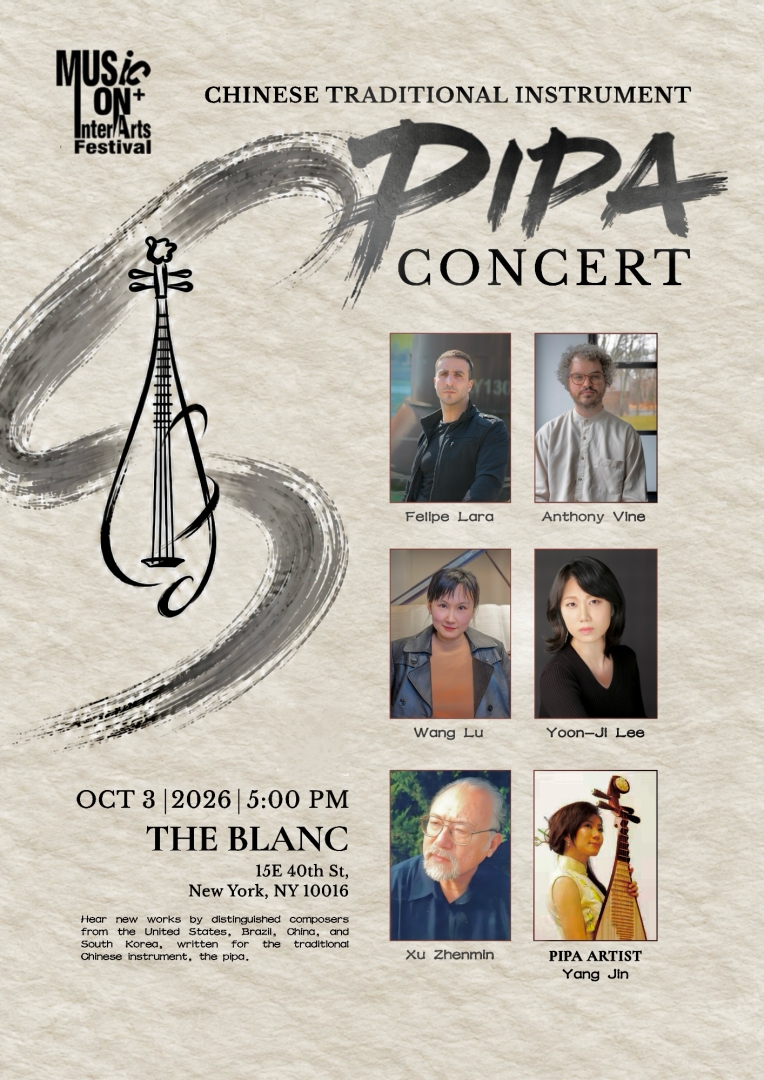
Pipa artist Yang Jin will give the world premieres of four works by composers Wang Lu, Felipe Lara, Yoon-Ji Lee and Anthony Vine, representing Chinese, American, Brazilian and Korean backgrounds, alongside the U.S. premiere of Song of the Pipa by the late Chinese composer and educator Xu Zhenmin (1934–2024).
Together, the five works return to the same underlying question: whether an instrument’s history is something to be preserved intact or raw material from which new music can emerge. Each composer answers it differently — through a manuscript, a painting, a disappeared tradition, a personal memory.
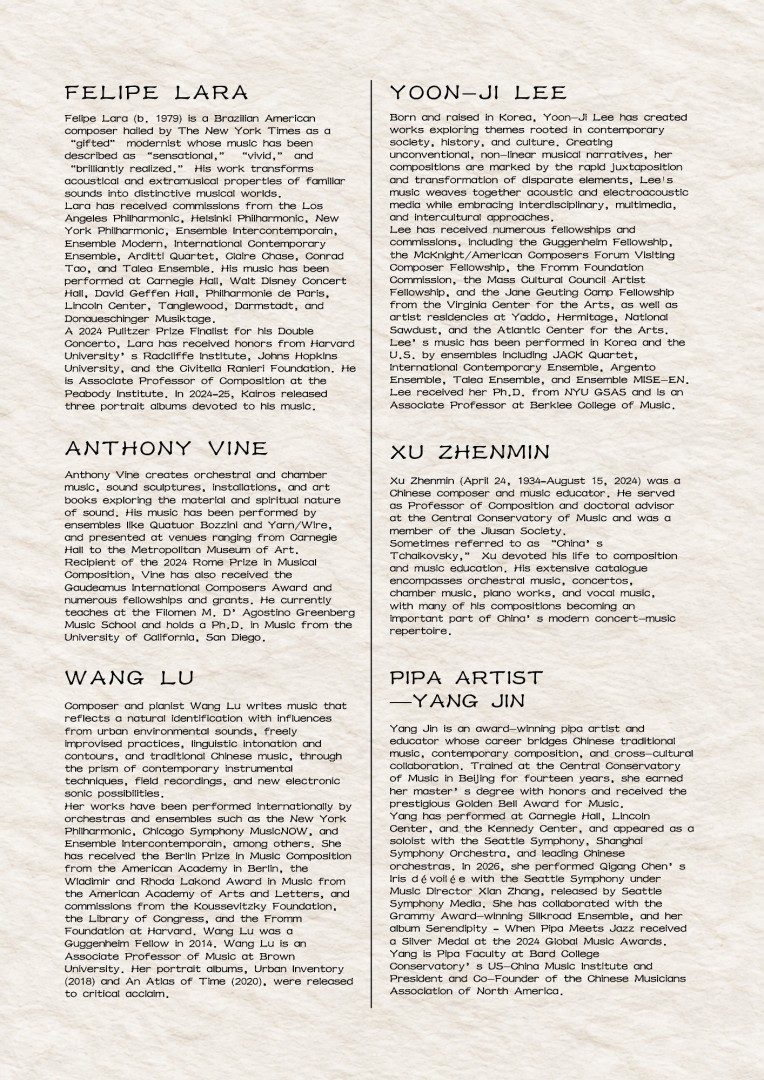
The four composers are established figures in contemporary composition, each recognized by some of the field’s most prestigious honors. Wang Lu, a tenured professor at Brown University, is a Guggenheim Fellow. Felipe Lara, chair of composition at the Peabody Institute of Johns Hopkins University, was a 2024 Pulitzer Prize finalist. Yoon-Ji Lee, who teaches composition at Berklee College of Music, is also a Guggenheim Fellow. New York-based Anthony Vine received the 2024 Rome Prize in Musical Composition.
From the Dunhuang Manuscripts to a New Musical Language
Wang Lu’s Unsaid, untold, for pipa and piano, takes its starting point from the Dunhuang pipa manuscripts — a set of ancient scores discovered among the Dunhuang cave documents, believed to date to the Tang dynasty and among the earliest surviving notations for the instrument. Their tablature-like notation has never been fully or uniformly deciphered, leaving scholars with more than one way to read the same fragments — a kind of built-in ambiguity that leaves room for interpretation rather than certainty.
Rather than reconstructing what the manuscripts might once have sounded like, Wang Lu treats that uncertainty as an opening. Melodic modes drawn from the fragments become raw material for something new, with pipa and piano echoing, intersecting and reshaping one another’s sound rather than presenting a single fixed reading of the source.
“This Is Not a Pipa”
Brazilian American composer Felipe Lara’s Ceci N’est Pas Une Pipa takes its title from René Magritte’s The Treachery of Images, the celebrated painting of a pipe accompanied by the words “Ceci n’est pas une pipe” — “This is not a pipe.”
Lara transfers Magritte’s question of object and representation to the pipa. Rather than quoting or reproducing the instrument’s traditional musical language, he approaches it through a contemporary concert-music lens. Pipa, harp and piano form a shared sound world of plucked, struck and resonating strings.
The instrument remains unmistakably a pipa, carrying its history in its construction, timbre and physical mode of performance. Yet its musical role is deliberately made unfamiliar — recognizable to the eye, estranged to the ear. Where Wang Lu remakes old material into something new, Lara leaves the material alone and remakes the listener’s assumptions about it instead.
Remembering a Pipa Tradition That Disappeared
Korean-born composer Yoon-Ji Lee’s Aftersong begins with a less widely known chapter of East Asian musical history. The pipa was part of musical life on the Korean Peninsula for centuries, where distinct traditions of hyang pipa and dang pipa developed, from the Three Kingdoms period through the Joseon dynasty. During the upheavals of the 20th century, its living performance tradition gradually disappeared, surviving largely through instruments, scores, historical documents and cultural memory.
Lee, who grew up in South Korea in the 1980s and 1990s, never encountered the pipa as a living Korean tradition. Aftersong draws on three historical sources — Nakyangchun, transmitted from Song-dynasty China to the Goryeo court and later transformed within Korean court music; Yeonggwan, the final movement of the Joseon court suite Jeongdaeeop; and sanjo, the virtuosic instrumental tradition that emerged in Korea in the late 19th century.
Rather than reconstructing what was lost, Lee composes from the shape of its absence. Here, the material isn’t the historical sources themselves so much as the silence that followed them — a lineage continued not by recovering what disappeared, but by writing from the fact that it did.
An Antiphon of Memory and Listening
Anthony Vine’s Antiphon — in memoriam Michael Harrison grows from personal memory. Vine met Michael Harrison only twice; on both occasions, plans to share and play music gave way to long conversations over lunch, and during their final meeting, a stopped clock caused time to slip away before a planned continuation of an improvisation could happen.
Looking back, Vine came to see music as something that remained at the edges of those encounters — connected by a particular way of listening, an attention not simply to the plucked or struck note itself, but to the overtones radiating outward from the sound. The composition also draws loosely on a 13th-century antiphon Vine encountered by chance, only later discovering that its Latin text concerned visitation, dialogue and transcendence.
For Vine, the inherited material is neither a manuscript nor a lost tradition, but a memory — a reminder that what carries forward isn’t always written down.
Xu Zhenmin and Song of the Pipa
Alongside four new works premiering in 2026 is Xu Zhenmin’s “Pipa Xing,” composed in 2000. A former professor and doctoral advisor at the Composition Department of the Central Conservatory of Beijing, Xu Zhenmin created works throughout his career across a wide range of genres including orchestral music, concertos, chamber music, piano, and vocal works. Commissioned by pipa virtuoso Zhang Hongyan, “Pipa Xing” draws inspiration from the eponymous long poem by the Tang dynasty poet Bai Juyi, reimagining through music the narrative and atmosphere of the poem—centered on the pipa, its performer, and the listener. Originally written for pipa and orchestra, this performance will feature the pipa and piano version, presented at the MusicON Festival founded by Mr. Wu Yiming (a former student of Xu Zhenmin), marking its U.S. premiere.
The convergence of Xu Zhenmin’s classic masterpiece with new-generation compositions in New York transforms “tradition” from an abstract concept into a living reality—music that continues to be heard, performed, and embraced by new audiences.
Yang Jin and the Pipa in New Musical Contexts
Pipa soloist Yang Jin, a recipient of the Chinese Golden Bell Award for Music, has built a career moving between traditional Chinese repertoire and contemporary and cross-cultural work. She has appeared at Carnegie Hall, Lincoln Center and the Kennedy Center, and performed as a soloist with the Seattle Symphony, Shanghai Symphony Orchestra, Royal Chamber Orchestra of Japan and Chamber Orchestra of Pittsburgh. In February 2026, she performed Qigang Chen’s Iris Dévoilée with the Seattle Symphony under Music Director Xian Zhang, released worldwide by Seattle Symphony Media in August as part of Zhang’s first recording for the orchestra’s label. She has also toured with the Silkroad Ensemble and Mark Morris Dance Group in Layla and Majnun, and her collaborative album with pianist Vince di Mura, Serendipity – When Pipa Meets Jazz, won a Silver Medal and Outstanding Achievement recognition at the 2024 Global Music Awards.
Yang is currently Pipa Faculty at the US-China Music Institute, Bard College Conservatory of Music, and co-founder and president of the Chinese Musicians Association of North America.
From the Dunhuang manuscripts and Korean court music to Magritte, memory and Bai Juyi’s poetry, the five works travel very different paths before arriving at the same instrument — each one answering, in its own way, whether history is something to preserve or something to build from.
Performance Information
2026 MusicON+ InterArts Festival — Master Concert
Date & Time: Saturday, October 3, 2026, at 5:00 p.m.
Venue: The Blanc, 15 E. 40th Street, 12th Floor, New York, NY 10016
Admission: Free and open to the public
About the MusicON Festival
Founded in 2022 by Chinese-American composer Yiming Wu, the MusicON Festival is an international music platform dedicated to original contemporary chamber music and works for chamber orchestra. The festival is committed to providing young composers from around the world with opportunities to present their works, exchange artistic ideas, and build meaningful collaborations.
Held annually in October in Manhattan, New York City, the MusicON Festival has presented 171 new works of contemporary chamber music over its first four editions and has collaborated with musicians from more than 20 countries and regions.
Media Contact
Company Name: MusicON Festival
Contact Person: Kathleen Kong
Email: Send Email
Country: United States
Website: https://www.musiconchamberorchestra.org/


